
With black pellets increasingly part of the conversation in biomass fuel procurement, buyers evaluating supply strategy are naturally asking how the two fuel types actually compare not in marketing terms, but on the practical factors that affect a real supply decision: cost, availability, application fit, and certification.
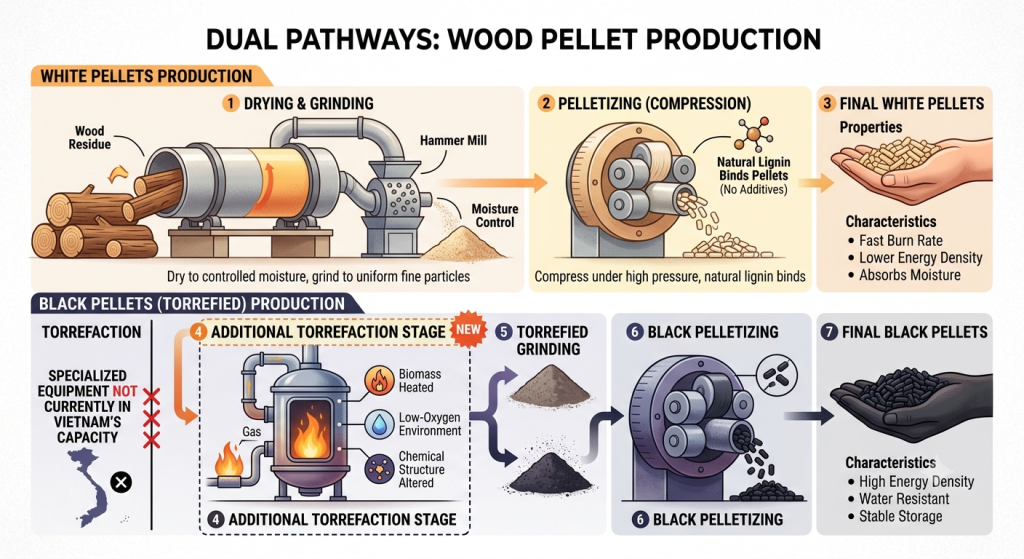
White wood pellets are produced by drying wood residue to a controlled moisture level, grinding it to a fine, uniform particle size, and compressing it under high pressure the natural lignin in the wood binds the pellet without any additional processing step.
Black pellets go through an additional torrefaction stage before pelletizing: biomass is heated in a low-oxygen environment to alter its chemical structure, producing a more energy-dense, water-resistant fuel but requiring specialized reactor equipment that most conventional pellet mills, including the vast majority of Vietnam’s production capacity, are not currently set up to run.
This is where the real difference lies for buyers. Black pellets are engineered primarily for coal co-firing blending biomass into an existing coal power plant’s fuel stream using largely unmodified coal-handling infrastructure. Their hydrophobic, coal-like handling characteristics are the whole point of the technology.
White wood pellets, by contrast, are the standard fuel for dedicated biomass power plants facilities purpose-built to burn biomass as their primary fuel, with storage, feed, and combustion systems designed specifically around wood pellet characteristics. This is the segment that dominates Vietnam’s current export market to Japan and South Korea.
If your project is a coal plant looking to blend in renewable fuel without major infrastructure investment, black pellets are the more natural fit. If your project is a dedicated biomass power facility, white wood pellets remain the established, purpose-built option.
This is a significant practical consideration: global black pellet production capacity remains a small fraction of the established white wood pellet supply base. Vietnam alone exports several million tonnes of white wood pellets annually to Japan and South Korea combined, backed by a mature, multi-producer supply chain. Black pellet production, by contrast, is concentrated among a smaller number of specialized producers, with overall global capacity still scaling.
For buyers needing large, reliable volumes on a predictable timeline, this capacity gap is a real factor not a temporary one that resolves quickly, given the capital intensity and specialized equipment required to build torrefaction capacity at scale.
Conventional wood pellets benefit from a well-established certification landscape: ISO 17225 defines internationally recognized quality grades, and schemes like ENplus and SBP provide third-party verified sourcing and quality assurance that many buyers now require as standard practice.
Certification frameworks specifically for torrefied biomass are comparatively less mature. Buyers evaluating black pellet suppliers should expect a less standardized landscape for verifying quality and sourcing claims, at least for now.
Black pellets typically carry a price premium over white wood pellets, reflecting the additional torrefaction processing step and the more capital-intensive production infrastructure required. Whether that premium is worthwhile depends entirely on the buyer’s application for coal co-firing projects, the reduced handling and storage infrastructure investment can offset a higher per-tonne fuel cost; for dedicated biomass plants already built around white pellet handling, that trade-off doesn’t apply in the same way.
These two fuel types aren’t really competing for the same buyer in most cases they’re solving different infrastructure problems. Buyers should let their own plant configuration and conversion goals guide the choice, rather than treating one as a strict upgrade over the other.
For buyers with dedicated biomass power requirements, Phu Tai’s FSC-certified white wood pellet production backed by 300,000 MT/year of combined capacity across three operating plants is built for exactly this segment. Request a quotation or contact our team to discuss specifications and supply planning.