
Vietnam’s wood pellet trade continued to move in April and May 2026, with export volume concentrating further toward Japan and a domestic industrial fuel market that while still small relative to exports shows Vietnamese manufacturers are also using wood pellets to power their own operations. Based on an internal analysis of trade shipment records for HS code 44013100, here’s what the two-month period looked like.
Note: the figures below are drawn from Phu Tai’s internal analysis of third-party trade shipment data and should be treated as approximate industry indicators rather than official government statistics.
Vietnam exported an estimated 1.22 million tonnes of wood pellets in April and May 2026 combined, worth approximately $179.5 million, at an average price of roughly $147 per tonne. That puts the two-month pace slightly ahead of the average monthly rate seen in Q1 2026, consistent with the broader multi-year growth trend in Vietnam’s wood pellet exports.
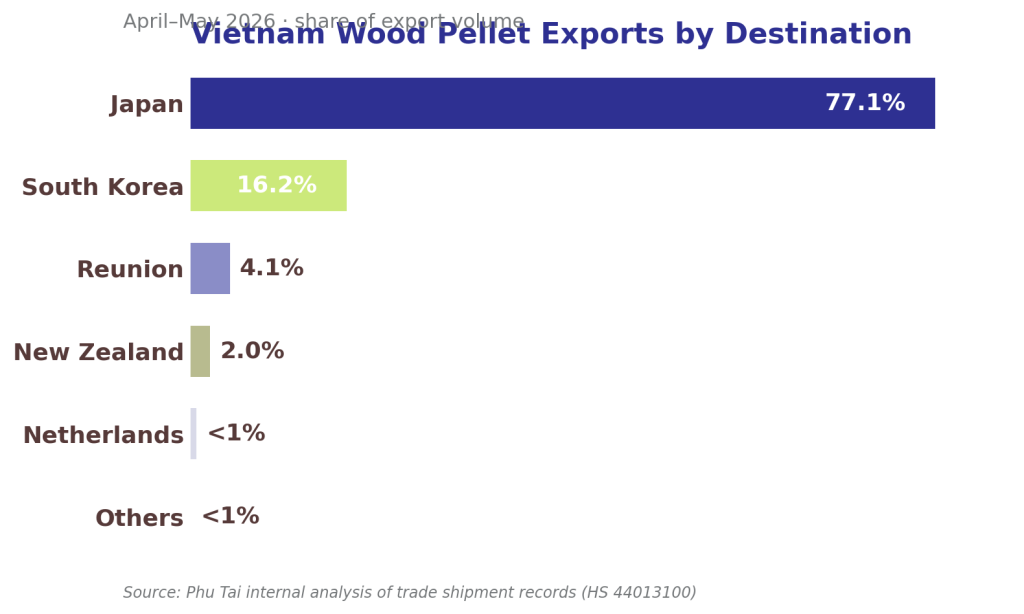
Japan absorbed roughly 77% of Vietnam’s wood pellet export volume in April–May 2026 up from an already-dominant share of around 73% in Q1 2026. South Korea held steady at roughly 16% of volume, a share broadly consistent with the prior quarter.
Pricing showed a similar pattern to previous periods: Japan-bound shipments commanded a modest premium (average price in the $150s per tonne) compared with South Korea-bound shipments (average price in the $110s–$120s per tonne), reflecting Japan’s generally stricter sourcing and certification requirements.
Smaller volumes moved to Reunion, New Zealand, and the Netherlands markets that have appeared consistently in Vietnam’s export data over recent quarters. Notably, our analysis also recorded a small first shipment to Laos in this period an early signal of Vietnam’s wood pellet trade extending into regional overland markets, distinct from the seaborne trade that dominates exports to Northeast Asia.
Comparing the April–May 2026 buyer records against Q1 2026, our analysis identified roughly a dozen international buying companies that appear to be sourcing Vietnamese wood pellets for the first time in this period a mix of trading houses and energy companies, primarily across Japan and South Korea. This kind of incremental buyer diversification is typical of a maturing export market: established buyers continuing long-term purchasing patterns, while new entrants test the market with smaller initial volumes before scaling into longer-term supply relationships.
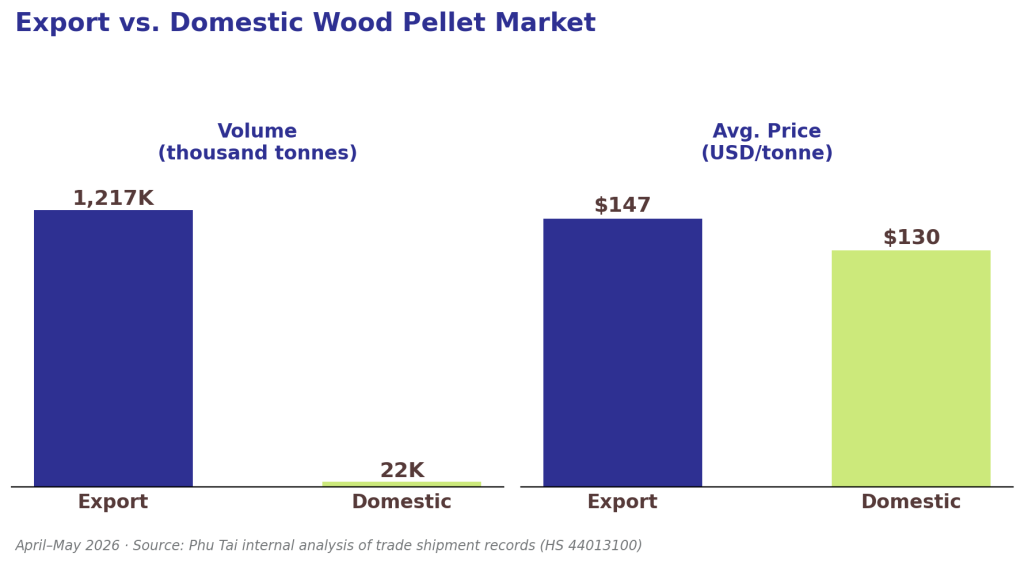
Alongside export activity, our analysis also captured domestic wood pellet transactions shipments where both the buyer and seller are based in Vietnam. In April and May 2026, this domestic segment accounted for an estimated 22,000+ tonnes, worth approximately $2.9 million, at an average price of roughly $130 per tonne modestly below export pricing, consistent with the absence of international freight and certification costs typically built into export pricing.
The buyers in this domestic segment span a noticeably broader range of industries than the export side, including manufacturing operations that use wood pellets as boiler fuel for their own production processes rather than for resale. This points to a secondary, steady demand base for Vietnamese wood pellets within the domestic industrial sector running alongside, and independent from, the export market that dominates industry headlines.
Two data points don’t establish a full-year trend, but the direction here is consistent with the broader pattern Vietnam’s wood pellet industry has shown over the past several years: export volumes concentrating further around Japan’s biomass power sector, steady South Korean demand, and early signs of geographic diversification at the margins. The domestic segment, while a fraction of export volume, is a reminder that wood pellets serve a dual role in Vietnam’s industrial economy as an export commodity, and increasingly as a domestic industrial fuel source in their own right.
For buyers evaluating Vietnamese suppliers, market-level trends are useful context, but supplier-specific fundamentals certification, production capacity, and raw material traceability remain the more relevant factors in any individual sourcing decision.
Phu Tai’s wood pellet operations, backed by FSC-certified forest resources and 210,000 MT/year of combined production capacity, are structured for long-term supply reliability in both export and domestic markets. Contact our team to discuss specifications and supply planning.