
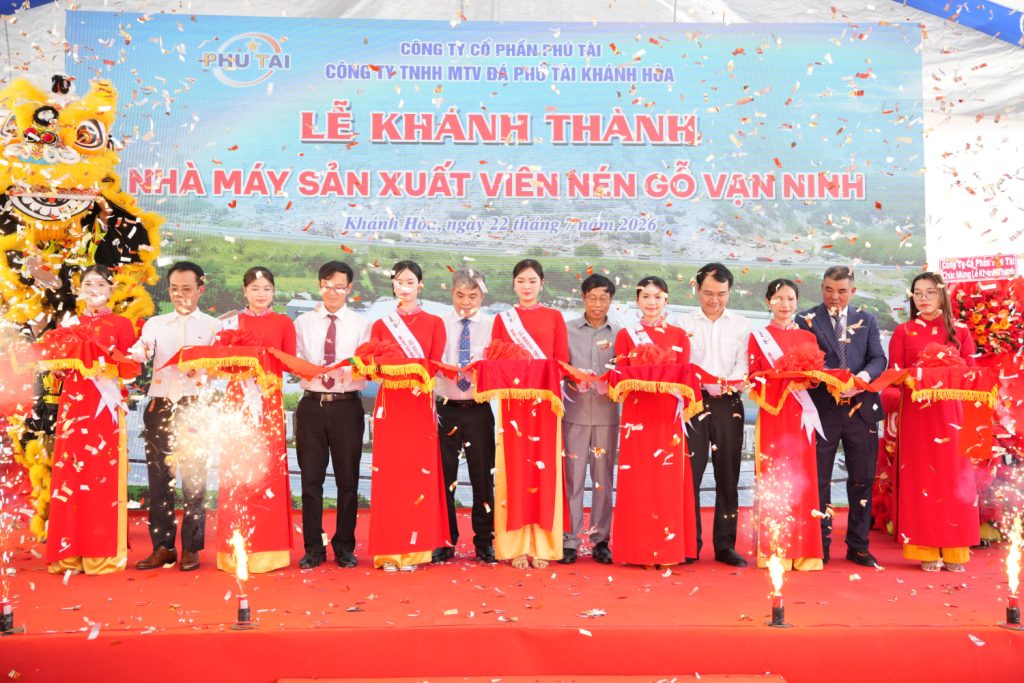
On July 22, 2026, Phu Tai JSC inaugurated its newest wood pellet manufacturing facility in Tu Bong Commune, Van Ninh District, Khanh Hoa Province the company’s third wood pellet plant, following earlier facilities in Phu Cat and An Khe, Gia Lai Province. The new plant brings Phu Tai’s combined wood pellet production capacity to 300,000 metric tons per year.
The Khanh Hoa plant sits on a site of approximately 45,807.6 square meters and is designed for two production lines: wood pellets for export, with a designed capacity of 90,000 tons per year, alongside a finished sawn timber line producing approximately 12,000 cubic meters per year.
Combined with the existing plants in Phu Cat (90,000 MT/year) and An Khe (120,000 MT/year), the addition of Khanh Hoa brings Phu Tai’s total wood pellet production network to three operating facilities and 300,000 MT/year of combined capacity part of the company’s phased expansion toward a longer-term roadmap of 1,000,000 MT/year across multiple plants.
Locating production in Khanh Hoa Province, in addition to the existing Gia Lai facilities, gives Phu Tai a wider geographic base for raw material sourcing and logistics supporting the company’s continued focus on serving buyers in Japan, South Korea, and European markets with a growing, multi-site production base rather than a single point of supply.
The new plant’s location in Van Ninh District places it close to the Van Phong Bay port cluster a deep-water port area Khanh Hoa Province has been actively developing for industrial and bulk cargo. South Van Phong Port already handles wood chips as one of its major export commodities, alongside general and bulk cargo, with berths capable of receiving vessels up to 70,000 DWT. North Van Phong, located within the same Van Ninh District, is designated in Vietnam’s national port master plan as a potential large-scale international transshipment hub.
For a bulk commodity like wood pellets, proximity to port infrastructure built for exactly this type of cargo rather than general-purpose ports retrofitted for the purpose is a meaningful logistics advantage as Phu Tai scales export volume from this facility.
The Khanh Hoa facility’s dual production lines sawn timber and wood pellets echo the same closed-loop model Phu Tai has applied at its Gia Lai plants: residue generated from wood processing becomes feedstock for pellet production, rather than a separate byproduct requiring separate sourcing or disposal. Readers interested in how this model works in practice can see a full breakdown in our earlier article on Phu Tai’s closed-loop supply chain.
A third operating facility strengthens Phu Tai’s position on two fronts that matter most to industrial buyers evaluating long-term supply relationships: production capacity and supply resilience. A multi-plant network reduces dependence on any single facility, supporting more reliable fulfillment for buyers planning multi-year procurement.
Buyers interested in current production capacity, facility details, or specifications are welcome to explore our Factory Systems page or request a quotation to discuss supply planning.